
Summary: Ethereum revenue is an essential metric for understanding the health of the second largest blockchain by market capitalization. In this article, you will find out how we calculate the revenue of Ethereum, how it changed after the EIP-1559 upgrade, and what is likely to happen to the price after the merger. / em>
Does Ethereum Have Revenue?
The short answer is yes: Ethereum generates revenue, but it is different from the company’s. The decentralized network generates revenue from fees paid to miners, in the form of new ETH tokens and gas fees. Historically, we have called it “Ethereum miner revenue” or “Ethereum miner revenue,” but that will change after the merger.
Ethereum was launched with a Proof of Work (PoW) consensus mechanism, which is maintained in a decentralized manner by the miners who keep the network running. However, due to scaling limitations and environmental impact, Ethereum is currently upgrading to a different consensus algorithm called Proof of Stake (PoS): see our investor guide for consolidation.
Upgrade London EIP-1559
On August 5, 2021, Ethereum implemented the so-called “London Upgrade.” One of the main parts of that fork was the integration of a file 1559 Ethereum Improvement Suggestion (EIP-1559), which affects the fee system on the network.
Ethereum users have to pay a cost per transaction in the form of gas, measured in ETH. The gas fee makes the network more secure, but the original fee system has some drawbacks.
Prior to EIP-1559, Ethereum relied on a price-first auction mechanism where users made an offer to the miner, indicating the cost they were willing to pay for adding their transaction to the next pool. Thus, miners were incentivized to choose the highest bids, with users often forced to overpay for transactions, as it was difficult to estimate the fair cost of bidding. If users submit very low fees, they are supposed to expect long delays.
Instead of the first rate auction approach, the EIP-1559 introduced a “basic fee” for transactions that would be added in the next batch. Users who want to prioritize their transaction can now pay a “tip” to the miner, called a “priority fee”: a higher tip results in a greater chance of your transaction being added to the next batch.
Base fees vary and are adjusted by protocol based on network demand. Like Uber’s surprise pricing, fees increase when Ethereum has a larger capacity and decrease when the network has a lower capacity.
Thus, the EIP-1559 helps users avoid paying excessive gas fees while preventing miners from artificially inflating the fees. Eric Conner, co-author of EIP-1559, Tell CNBC, “This is great for casual Ethereum users and makes using the protocol less intimidating.”
Moreover, the EIP-1559 introduced a contraction mechanism, whereby miners receive only the tip, with core fees burned, i.e. removed from circulation. This can be viewed as an Ethereum buyback mechanism that reduces the supply of tokens and can make your Ethereum investment more valuable in the long run.
this is the reason “The EIP-1559 is one of the most important Ethereum upgrades since the launch of the networkAccording to Meltem Demirors, Chief Strategy Officer at CoinShares.
Ethereum revenue since upgrade
First, the good news: Ethereum’s revenue has skyrocketed after the upgrade.
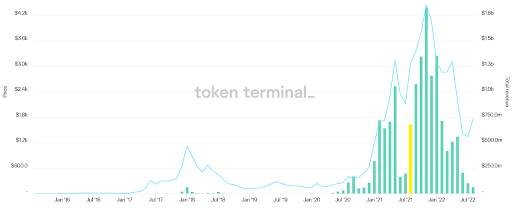
Now the bad news: Ethereum revenues in 2022 are strained.
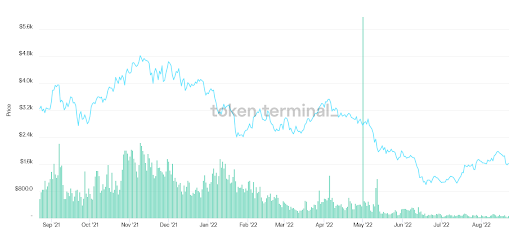
The takeaway for the investor is that Ethereum saw revenue increase for about six months after the EIP-1559 upgradewith a general downtrend that follows.
There are certainly many other factors at play besides the Ethereum upgrade: the proliferation of DeFi services, new waves of NFT projects, and a swarm of developer activity. Takeaway is that The update did not hinder these developments, but helped them.
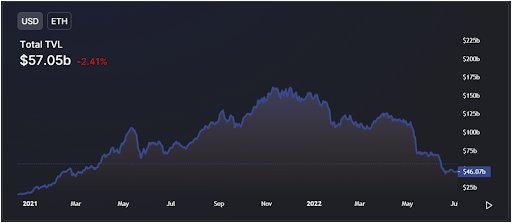
Case in point: November 2021 was the most active month for DeFi on Ethereum, with the total closed value exceeding $160 billion. Despite the decline in TVL since then, Ethereum remains the most dominant chain in DeFi.
Elsewhere, NFT market volumes rose nearly 2,500%, from $509.36 million to $12.93 billion. In the first quarter of 2022, volume numbers crossed $200 billion, with NFTs making headlines.
Final advice to the investor: Ethereum’s inflation rate has gradually decreased since the London upgradedue to the combustion mechanism introduced by EIP-1559.
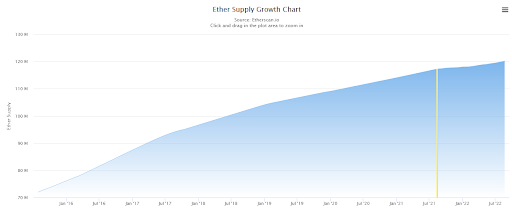
You can clearly see the slowdown in inflation after EIP-1559, which is good news for Ethereum investors. (The less ETH issued, the larger the pie you own.) Upcoming Ethereum upgrade may slow inflation further; Ethereum may become deflationary.
Revenue of Ethereum vs. Other Blockchains
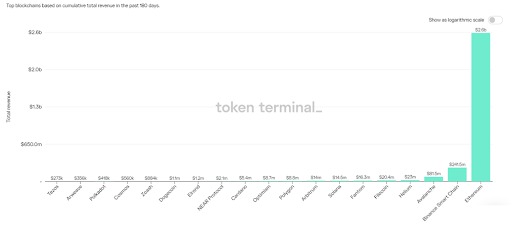
Ethereum is the second largest cryptocurrency by market capitalization. Its blockchain network is used by thousands of projects related to dapps, DeFi protocols, Layer 2 solutions and NFTs. Thus, the Ethereum network has the highest demand compared to other chains.
Other major blockchains, including Solana, Binance Chain, Cardano, Avalanche, and Algorand, use different versions of the PoS algorithm, and do not charge miners a fee. However, they also have a revenue metric that reflects network activity. None of the blockchains in PoS came close to Ethereum in total revenue.
How will the merger affect Ethereum revenue?
The merging ethereum It is the most important stage in the gradual upgrade to point of sale. Set to take place in September 2022, it marks the long-awaited transition from Proof of Work to Point of Sale.
Last year, Ethereum introduced the Beacon Chain as an initial stage of the upgrade. Beacon Chain is a PoS network that enables users to share ETH and become block validators. However, the beacon chain has served as a secondary network in parallel to the main Proof of Work network.

The merger will bring together the beacon chain and the mainnet, ending Ethereum mining for good. After the merge event is completed, the stakeholders will step in to validate the blocks instead of the miners.
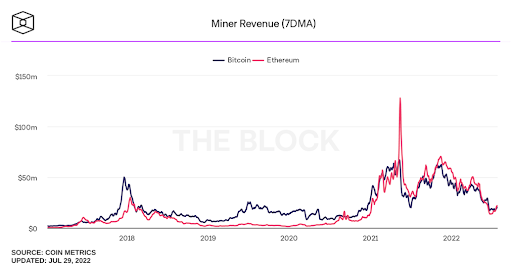
The significant drop in mining revenue already reflects the consolidation approach, as miners will no longer be able to monetize their efforts. The move to PoS is forcing the $19 billion Ethereum mining industry to look for other PoW cryptocurrencies.
At this point, the Ethereum revenue metric will reflect transaction fees paid to miners rather than miners. Speaking of fees, they probably won’t go down, According to DeFi researcher.
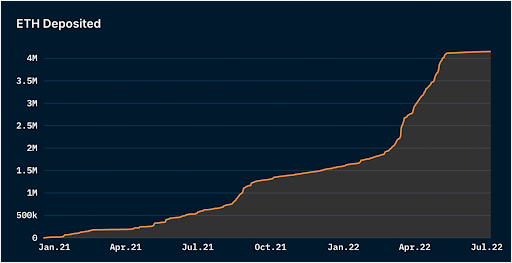
On a side note, the amount of ETH tethered in the beacon chain continues to increase.
Ready meals for the investor
- Ethereum revenue is a key metric because it reflects activity on the network. Investors can think of it like the revenue an Ethereum “company” gets.
- Since Ethereum plays an essential role in the crypto industry, Ethereum’s revenue indirectly reflects the health of DeFi, NFTs, and the broader Web3 industry.
- for investors, Ethereum revenue is a more important number than Ethereum market cap. Market value is more than a function of investor sentiment; Revenue is a function of actual use.
- The merger will change the way Ethereum revenue is calculatedFrom fees paid to miners to fees paid to miners.
- finally, Ethereum revenue soared after EIP-1559 upgradeThis could be a very good sign for investors in The Merge.
Subscribe to the Bitcoin Market Journal to get more exclusive insights into Ethereum (find this out before the market).
0 Comments